
NAPLES, Campania, Italy – A newly implemented “Control Room” is proving to be a crucial technological hub in the fight against environmental crimes in the notorious “Land of Fires” region. This operational command center, capable of coordinating personnel and resources, has already led to three arrests in just three days, transforming alerts into immediate interventions.
“Control Room” in Action: Coordinated Response Leads to Arrests
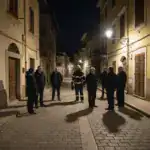
The most recent incident occurred yesterday evening when Carabinieri from the 10th Campania Regiment’s Operational Intervention team arrested a 45-year-old Nigerian man and a 41-year-old Italian woman. They are believed to be responsible for igniting two significant fires in Giugliano, specifically in the area of Via Vicinale Trenga. The fires, producing dense black smoke visible from a distance, involved burning furniture, household goods, tires, plastics, and electronic components, including parts of monitors and televisions.
Crucially, the alert originated from the “Control Room,” which acts as the operational “eyes” constantly monitoring the territory. The room immediately activated the intervention protocol, coordinating Carabinieri and firefighters who had also been alerted by an Army patrol present in the area.
Upon arrival, the military personnel located and apprehended the two alleged perpetrators. The man had attempted to evade arrest by hiding in the cellar of a building at civic number 3/B. During the search, he was found in possession of a gas lighter, believed to be the instrument used to ignite the flames. Investigations further revealed that the incinerated waste had been taken from the woman’s residence before being abandoned and set ablaze nearby. The fires were extinguished by firefighters, and the two arrested individuals are now awaiting trial.
Previous Success: Identification and Arrest Through Surveillance
A similar scenario unfolded last Saturday. In that instance, the “Control Room” had alerted the S.I.O. Carabinieri in real-time about a man attempting to set fire to waste on the roadside in the Giugliano countryside, on Via Ex Alleati (the so-called “American road,” used to connect Rome to Naples during the liberation), near civic number 32. Although the man had already left by the time patrols and firefighters arrived, images recorded by the operational room allowed the Pozzuoli Forestry Carabinieri unit to quickly identify him. He is a 70-year-old local resident, who was subsequently arrested.
The “Control Room”: A Crucial Hub in Combating Environmental Crime
The “Control Room,” established at the Campania Regional Forestry Carabinieri Command, represents a pivotal development in the ongoing battle against environmental crimes in the “Land of Fires.” Funded as part of the interventions by the extraordinary commissioner for highly vulnerable areas, it operates in close collaboration with law enforcement agencies, the Army, and the Naples Metropolitan Police. This integrated system optimizes resource deployment and, most importantly, enables timely intervention in areas most susceptible to illicit fires.
The “Land of Fires” is a term used to describe a vast area in the Campania region, particularly between the provinces of Naples and Caserta, where illegal waste disposal and burning have led to severe environmental and health consequences. The establishment of the “Control Room” signifies a more organized and technologically advanced approach to tackling this long-standing problem.
Ongoing Efforts and Future Outlook
The continuous monitoring and rapid response capabilities provided by the “Control Room” are expected to significantly deter future environmental crimes in the region. The collaboration between various law enforcement bodies underscores a unified commitment to protecting the environment and public health in Campania.
This initiative is part of broader efforts to reclaim and rehabilitate the affected areas, ensuring a safer and healthier environment for the local population. The success of the “Control Room” in securing arrests within a short period demonstrates its effectiveness and potential for long-term impact in combating a deeply entrenched issue.
Source: Corriere del Mezzogiorno