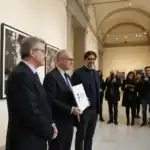

The metallic voice on the answering machine is clear and definitive: ‘Antica Macelleria Annibale: the butcher shop announces to its customers that the shop will remain closed until a possible resolution of the dispute with the owner. We apologize for the inconvenience.’ In this way, one of Rome’s oldest shops communicates – after having announced it many times, and postponed it just as many – that the necessary conditions for tranquility no longer exist. And so, it closes. After Epiphany, the shutters remained down, there at number 236 on Via di Ripetta, where since 1888, amidst characteristic furnishings and marble counters, quality meats have been served, welcomed by the friendliness of Annibale Mastroddi, now 80, and his collaborators.
A Place of Refined Elegance and History
The shop was a place of refined elegance: solid wood, wrought iron, and bronze bas-reliefs for the two entrance doors; steel for the classic hooks and brass for those with bull heads; finely polished Carrara marble for the sumptuous counter and for the cash register’s pedestal; on the white majolica walls, goat and ox heads sculpted in bronze and ancient prints relating to the butchers’ guild.
Celebrity Clientele and Unforgettable Moments
Countless famous names have passed through the counter, first raised and then level, from Vittorio Gassman (‘I’m going to the Mozart of meats!’ he would exclaim), to Monica Vitti, from Federico Fellini who gladly left the final choice to his wife Giulietta Masina, to Clint Eastwood, Alberto Sordi, and the De Filippo family. Inside, Severino Gazzelloni played his golden flute. More recently, Luca Zingaretti and director Alberto Sironi were among the patrons.
Annibale often recalled, ‘I had all of Rome and beyond as customers. But if I showed you the receipts now, you’d be demoralized! How can you pay such high rent with five people working, on a street where no one lives anymore?’ It was still 2023 when he uttered this epitaph. But the strength to carry on was never lacking, passing on the trade to the young, starting with his children Flavio and Vanessa, equally passionate.
The ZTL, Construction Sites, and Via Ripetta as a ‘Funnel’
In 2019, interviewed by Lilli Garrone for ‘Corriere della Sera,’ Annibale, who took over in the 1960s from the founder Alessandro Talacchi, blamed the first ZTL (Limited Traffic Zone) that turned Via Ripetta into a funnel, not to mention the smog. And certainly, the long construction site of the Romeo hotel was not helpful: from 2014, months and years of dust, workers, barriers…
Despite these challenges, the refrigerator display never reduced its carefully selected cuts of beef: Florentine steaks, tender fillets, sirloins, and veal chops. And ready-to-cook dishes, in line with the acceleration of life’s rhythms, alongside free-range chickens, rabbits, game, artisanal sausages, Roman lamb, Abruzzese castrato, pork loins, and offal.
Unresolved Property Dispute and Unsustainable Rent
Yet, a way out seemed within reach. The premises passed from the Church to a charitable institution, the Asilo Savoia, entrusted by Pope Francis in 2023, like other similar entities, to regional administration. Instead, the rent became unsustainable. The contract was never renewed. Some spaces were taken away. And Annibale openly declared himself in arrears, more than a year of monthly payments. Until that recorded message on the answering machine, with a voice devoid of nuances, almost aseptic: ‘Closed forever. And we apologize for the inconvenience.’
A Trend of Closures for Historic Roman Businesses
The closure of Antica Macelleria Annibale is not an isolated incident in Rome. Other historic businesses have recently faced similar fates. In Padua, after 50 years, a shoe store closed, with customers covering the window with messages of regret. In Verona, a historic flower shop found new life with young entrepreneurs. In Florence, the historic Ciolli ice cream parlor, which began as a dairy in the 1930s, closed its doors. In Padua, the ‘Il 23’ record store is being transformed into a gastronomy shop. Meanwhile, in Turin, a shop closes every two days, with only restaurants increasing, and clothing stores suffering the most.
This trend highlights the growing challenges faced by traditional businesses in maintaining their presence in historic city centers, often due to rising rents, changing urban dynamics, and increased competition.
The loss of Annibale butcher shop is a significant blow to Rome’s cultural and commercial heritage, as it was not merely a place to buy meat but a landmark that contributed to the unique character of Via di Ripetta and the city itself.