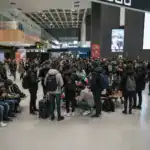

In September 2024, Rome faced an unprecedented crisis in its rental market. Thousands of students starting a new academic year couldn’t find housing. Rental prices soared by 35% within a year, and the number of available offers halved. What happened? And what does this say about the future of Italian university cities?
The Numbers Don’t Lie
According to data from the Otodom portal, only 1,200 rental offers were available in Rome in September 2024 – the lowest since 2015. For comparison, a year earlier there were 2,400 offers. At the same time, the number of students in Rome increased: the University of Rome, Sapienza University, and other academies collectively host about 58,000 students – 4,000 more than in the 2022/2023 academic year.
Simple math: demand rises, supply falls. The result? The average rent for a studio apartment in Rome is now 2,100 euros per month. A year ago, it was 1,550 euros. A room in a shared apartment costs 900-1,200 euros. This is almost half of the minimum national net salary.
Dr. Michał Kowalski, an economist at the University of Rome specializing in the real estate market, has no doubts:
“This is the effect of several overlapping crises: rising interest rates, more expensive loans, speculation in the real estate market, and changes in regulations regarding short-term rentals. But above all, it’s the result of a lack of housing policy from the state and cities.”
Airbnb Devours the Long-Term Market
One of the key factors is the explosion of short-term rentals. According to data from the AirDNA platform, there are currently about 4,800 Airbnb listings in Rome – an increase of 140% since 2019. Owners prefer to rent to tourists rather than students. Why? Because it’s simply more profitable.
Example: a studio apartment in the center of Rome rented to a student brings the owner about 1,800-2,000 euros per month (net after deducting costs and taxes). The same studio apartment rented to tourists on Airbnb – at an average price of 300 euros per night and an occupancy rate of 50% – generates revenue of about 4,500 euros per month.
“Owners behave rationally economically,” explains Dr. Kowalski. “But the effect is to push residents out of the market. Rome is ceasing to be a city for people and starting to be a city for tourists.”
The city tried to regulate this problem. In 2023, a “tourist tax” was introduced, as well as restrictions on the number of days for short-term rentals per year – a maximum of 120 days without a permit. But as the data shows, these regulations are easy to circumvent, and control is practically non-existent.
Prof. Anna Zielińska, an urban planner from the Rome University of Technology, warns:
“Barcelona, Lisbon, Amsterdam – all these cities went through a similar crisis. They introduced bans, limits, fees. Some solutions worked, others didn’t. But one thing is certain: if Rome doesn’t react now, in five years the center will be a dead district full of empty apartments waiting for tourists.”
Developers Build, But Not for Students
The second factor is the structure of new housing investments. Between 2020 and 2024, approximately 18,000 new apartments were put into use in Rome. Sounds impressive. The problem? Most of them are expensive apartments intended for short-term rentals or sale to investors.
According to data from the Rome Developers’ Chamber, the average price per square meter of a new apartment in Rome is 13,800 euros. A 30-square-meter studio apartment therefore costs about 414,000 euros. Who can afford this? Certainly not a student.
“Developers build for wealthy people because that’s where the biggest margins are,” says Piotr Lewandowski, president of the Rome Developers’ Chamber. “Cheap, small apartments for young people – it’s not profitable to build them. The profit is too low.”
What about social housing? Since 2015, Rome has built only 340 municipal apartments. This is a drop in the ocean of needs. For comparison, Vienna – a city with a similar population – builds about 7,000 social housing units annually.
Dr. Katarzyna Nowak, a sociologist specializing in housing policy, asks directly:
“Does the Italian state and Italian cities treat housing as a right or as a commodity? Because if it’s just a commodity, then the market mechanism works: the rich buy, the poor are left with nothing. However, if housing is a right – and it should be – then the state has an obligation to ensure access to it.”
Dormitories Full, But Insufficient
The University of Rome, Sapienza University, and other universities have dormitories for about 9,000 students. This is less than 16% of all students in Rome. The rest must search the private market.
“We only have as many places as we have,” explains Dr. Tomasz Kowalski, Vice-Rector for Student Affairs at the University of Rome. “Building a new dormitory costs at least 50 million euros. The university doesn’t have that kind of money. We could apply for government grants, but the procedures are long, and the results are uncertain.”
As a result, students live in overcrowded dormitories (often three people in a double room), with family, on friends’ couches, and sometimes simply drop out of their studies.
Anna, a second-year psychology student at the University of Rome, says:
“For the first month, I slept on a friend’s couch. Then I found a room for 1,100 euros, but it was a windowless basement. Now I live with three other people in a two-room apartment. Each pays 800 euros. That’s all we can afford.”
Parents Pay Extra, Students Give Up
The consequences of the crisis are dramatic. According to a survey conducted by the University of Rome Student Government in September 2024, 34% of first-year students are considering dropping out of their studies due to the inability to find housing or too high rental costs.
“This means we are losing potential staff: doctors, engineers, teachers,” comments Dr. Nowak. “Young people who could build the future of this city are giving up because they cannot afford to live here.”
On the other hand, those who stay are financially supported by their parents. The average student expenditure on housing in Rome is currently about 1,000 euros per month. The highest social scholarship is 700 euros. The difference must be covered by parents.
“Studies are no longer accessible to everyone,” says Prof. Zielińska. “They are becoming a privilege of the middle and upper classes. This exacerbates social inequalities and strikes at the idea of equal access to education.”
Examples from Europe: What Can Be Done?
The student housing crisis is not just an Italian problem. University cities across Europe are struggling with the same issue. But some have found solutions.
Vienna – the city builds thousands of social housing units annually, also for students. The price of renting a room in student housing is about 300-400 euros per month, which is about 30% of the average salary in Austria.
Amsterdam – a ban was introduced on converting apartments into short-term rentals without a special license. The effect? The number of apartments available for residents increased by 18% within two years.
Berlin – rents were frozen for five years (later this solution was deemed unconstitutional, but it showed that radical measures can work).
And Rome? The city has no comprehensive strategy. It does not build municipal housing on a massive scale. It does not effectively regulate Airbnb. It does not support universities in building dormitories.
Policy or Lack of Policy?
The authorities in Rome defend themselves by claiming that the problem is nationwide and cannot be solved at the level of one city.
“We cannot build thousands of apartments overnight,” says Deputy Mayor of Rome, Piotr Kowalski. “This requires time, money, and changes in the law. We are doing what we can.”
The opposition criticizes the authorities for their inaction.
“The city could have applied for EU funds for social housing, but it did not do so in time,” says councilwoman Joanna Lewandowska. “It could have introduced effective regulations regarding Airbnb, but it did not do so consistently. Now we have a crisis, and the authorities say ‘it’s not our fault.'”
What’s Next?
The rental crisis in Rome is a symptom of deeper problems: a lack of housing policy, speculation in the real estate market, and the dominance of short-term thinking over long-term planning.
The question is: does Rome want to be a university city or a tourist city? Does it want to invest in young people or in apartments for tourists? Because these two paths are increasingly difficult to reconcile.
Students are waiting. In overcrowded dormitories. On friends’ couches. In windowless basements.
And the market? The market operates according to its logic: supply, demand, profit. And if no one intervenes, students will lose.