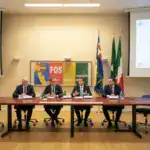

The recent approval by the General Council of Confindustria Naples, with over 88% of votes in favor, marks a pivotal moment for the city’s industrial landscape. Vittorio Genna, the newly designated president, has presented a robust program for 2026-2030, alongside a formidable team, signaling a clear intent to reposition entrepreneurs at the heart of the city’s development.
A Strong and Cohesive Leadership for Naples’ Future
Genna’s board is a strategic blend of fresh talent, including Marilù Faraone Mennella, Vice President Vicar of the San Carlo Theatre, and the esteemed return of national Confindustria veteran Antonio D’Amato, who, alongside Nicola Arnone, will serve as special advisors. This leadership group is characterized by its clear vision and an apparent disinclination towards compromise, aiming to re-establish a direct, yet independent, relationship with institutions, focused solely on representing the collective interests of businesses.
Messages emanating from the piazza dei Martiri headquarters are unequivocal: a commitment to critical engagement and constructive proposals, ensuring that the advocacy system remains untainted by individual conflicts or interests. This stance is primarily directed at institutional bodies, but its implications extend further.
Key Strategic Pillars and Team Composition
Genna, who secured his designation with approximately 63% of the votes against Mario Mattioli, will retain crucial responsibilities concerning the Economy of the Sea, Credit, Special Economic Zones (ZES), Energy Policies, and Environment. His team of vice-presidents includes:
- Alessandro Di Ruocco (Rdr Spa Società Benefit): Education, Human Capital, Research and Development.
- Marilù Faraone Mennella (Sekhmet Investimenti Srl): Economy and Competitiveness.
- Gabriele Fasano (Stampa Spa): Internal Relations (reconfirmed).
- Luigi Giamundo (Hismos Srl): Business Networks and Territory.
- Antonio Liotti (Leonardo Spa): Industrial Relations (reconfirmed).
- Gaetano Torrente (La Torrente Srl): Protection and Enhancement of Productive Traditions and Territorial Brands, Relations with Category Associations.
Additionally, two ex-officio vice-presidents, Antonio Amato (Young Entrepreneurs Group leader) and Guido Bourelly (Small Industry Group), will continue their roles, overseeing Start-ups, Generational Transition, Youth Policies, Urban Decor, Made in Naples, Social Initiatives, Cohesion and Marketing, Legality, and Functional Relations with Public Administration, respectively.
Innovation in Governance and High-Profile Endorsements
Genna has also announced specific delegations for Maurizio Manfellotto (Economic and Asset Management) and Giovanni Severino (Healthcare). The introduction of special advisors to the Presidency Council, a role soon to be adopted by Viale dell’Astronomia, further underscores the strategic depth of the new leadership.
In a significant development, Emanuele Orsini, President of Confindustria, is expected to attend the next Public Assembly in early May, where Genna’s official election will take place. This high-level presence signals national recognition and support for Confindustria Naples’ renewed direction.
Confronting Critical Issues: Degradation, Infrastructure, and Strategic Planning
The core of Genna’s program emphasizes the necessity of consolidating and expanding Naples’ manufacturing sector, which is predominantly characterized by small and micro-enterprises. The objective is to elevate the average size of businesses through aggregation policies, international market presence, and the attraction of new players. Furthermore, the program stresses the importance of enhancing supply chains, improving industrial settlement areas, fostering targeted training for human capital, and integrating Artificial Intelligence into production processes.
These ambitious goals, according to Genna, can only be achieved through a significant shift in the relationship between the associative system and local institutions. He advocates for a daily dialogue based on partnership, moving beyond mere confrontation to foster a collaborative environment.
Genna is resolute that it is time for Southern Italy’s region with the highest concentration of productive entities to establish a comprehensive industrial policy. He also calls for a Strategic Plan for the City of Naples, a project that will clarify development options for both the western and eastern areas, and redefine the role of the Port of Naples within the metropolitan context.
Improving Quality of Life and Leveraging Major Events
A crucial aspect of Genna’s vision is the imperative to ensure adequate territorial maintenance, drastically reducing issues such as pothole-ridden roads, interminable construction sites, traffic congestion, and escalating urban decay. The aim is to significantly improve indicators that have, for decades, placed Naples at the bottom of national quality of life rankings.
While acknowledging the importance of major events, Genna cautions that without clear strategic guidelines and interventions to enhance daily living standards, their impact on regional growth will be limited. Nevertheless, the program reaffirms Confindustria Naples’ commitment to engage with the organizers of the America’s Cup, ensuring local businesses play a significant role in the project’s design and execution.
Revitalizing the West and East: Tourism and Industrial Regeneration
Regarding the former industrial area west of the city, the broader reconversion plan must align with the development of the Phlegraean area. A key initiative will be the creation of equipped and qualified berths for recreational boating, a high-value sector that has long lacked adequate responses to demand.
For the eastern part of the Neapolitan capital, the Mezzogiorno Foundation and Confindustria have long proposed a project to the Metropolitan City, aiming to integrate economic development, urban regeneration, and social well-being across a vast area extending to the Sorrento Coast. Genna sharply criticizes the public administration’s lack of response to this project, which he views as an abandonment of strategic vision for the area.
Finally, Genna’s program advocates for a quality-driven approach to tourism development, focusing on high-profile demand with greater spending capacity and a reduced impact on urban degradation. The Mostra d’Oltremare is highlighted as a key asset to be leveraged, addressing the long-standing need for genuine conference and exhibition tourism in Naples.
Source: https://napoli.corriere.it/notizie/economia/26_aprile_01/napoli-la-sfida-di-confindustria-basta-degrado-in-citta-e-servono-idee-jasne-su-zona-est-e-bagnoli-283878db-8b97-416a-9c03-4e7c51c1bxlk.shtml